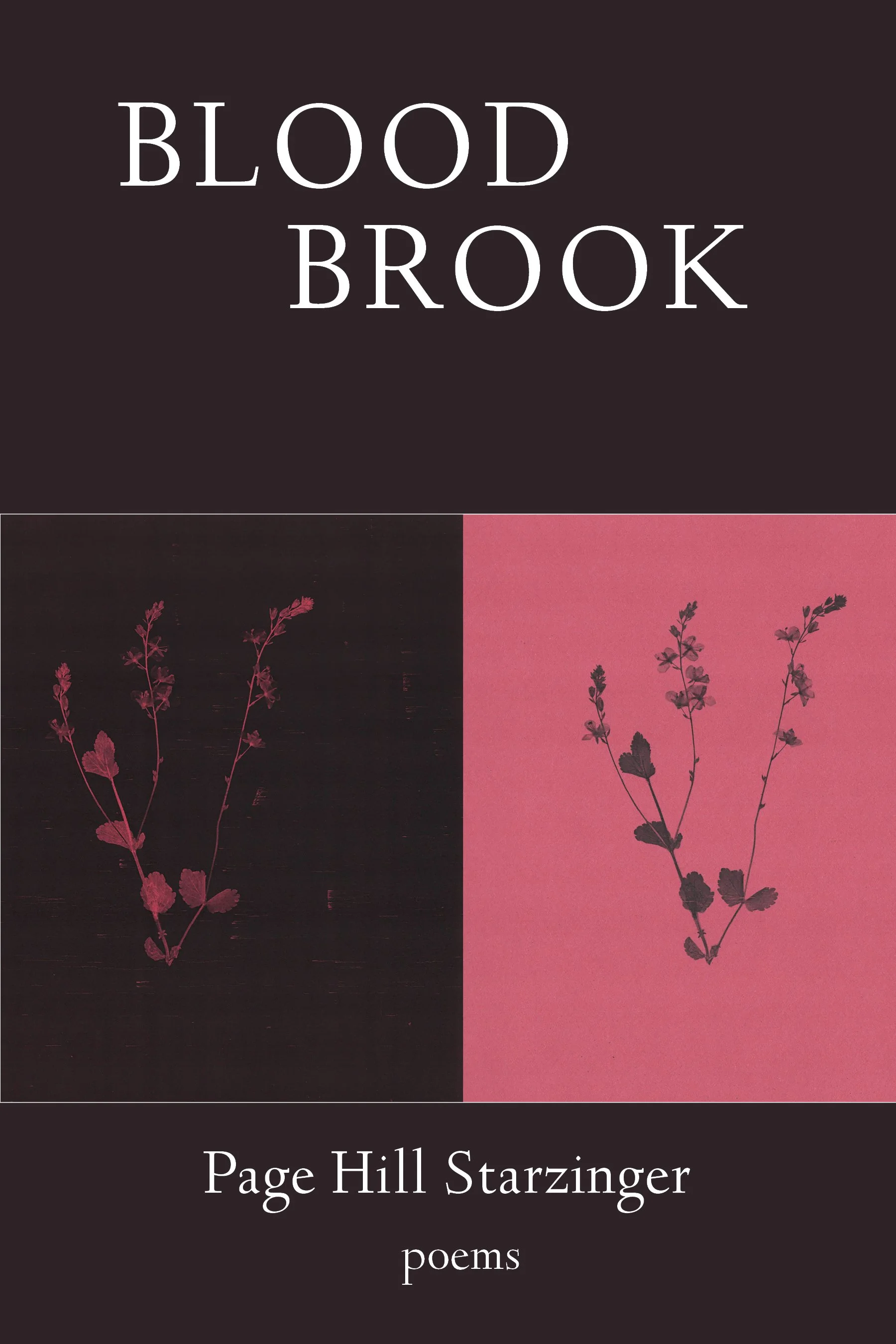
Cover art by Kate Goodrich
Cover design by Maisonneke
BLOOD BROOK
2027
“We thought it was named for a family. Or a slaughter,” the title poem of Blood Brook begins, and this surprising dichotomy defines the book’s territory. Ideas of family—in reality but also in pure potential, perhaps unrealizable—form Starzinger’s central subject here, and her contemplation of it is subtly harrowing. Through wordplay, pasts and futures real and imagined, and a quiet pervasive grief, Blood Brook reveals a brilliant world seen through spectral windows of loss and desire. “I become part / of another world there / where I emerge in my last //—long-lasting—form. / A ghostly heir….” Torn between humanity’s physical and metaphysical beauty and pain, Starzinger’s poems shimmer but never fade. This book is gorgeous, and disturbing in all the best ways.
—T.R. Hummer
Blood Brook is the work of a woman who, rather than increasing the generational stock, takes stock—and what a harsh and tender reckoning it is, to face aging and mortality without family, while staring down the ghosts of what might have been. Page Starzinger’s honesty is transformational; her craft, impeccable. I will read this book whenever I need to search my own most shadowy hideouts and bring the wild abundance of what’s found there to light in a poem.
—Kathy Fagan
Many voices flow through Page Starzinger’s haunting Blood Brook—voices of the dead, ghostly presences, sounds “like a cello might make, / before it was crafted into an instrument.” At its heart is the aching echo of an unborn child. With a witty interiority, an exquisite, incantatory music, these poems trace rhythms of the mind as it moves through time and language and conjures its losses. Our time is fleeting, yes, but, this beautifully orchestrated collection asks, “is / lasting // really the point anyway?”
—Donna Masini
Page Hill Starzinger’s remarkable poems reside in the world but resist the limitations of experience; they inhabit the body but resist the limitations of the self. Blood Brook is at once grounded in delicious particulars, and blown out, expansive, traveling beyond the beyond. This collection has much to teach us about liminality, lineage, and the durability—and elasticity—of language.
—Maggie Smith